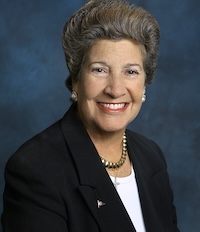
Chase alumna Hortensia Sampredo – who came to the United States from Cuba as a 10-year-old with her sister and with $10 in their pockets – will be inducted into the Cuban Bankers Hall of Fame on October 22, 2026.
She is the second woman to be so honored by the Cuban Bankers Study Group since it created the Hall of Fame in 2023. (The late Ulises Giberga, who worked for Chase from 1953 to 1987 – including in Cuba when Castro nationalized Chase Manhattan's branches there – was part of the inaugural Hall of Fame class of 36 men.)
Sampredo has grown accustomed, however, to being the first woman and often the first Hispanic to break various glass ceilings. She says she was the first Hispanic woman to participate in the Credit Training program at Chase (CC6, in 1972), following the handful of women who had entered the program in 1970, and the first female Commodore of the Key Biscayne Yacht Club.
Currently a professor at Florida International University (FIU), Sampredo has not been a banker since she left Chase Manhattan in 1991, but said the principles she and her husband, Chase alumnus Bob Hacker, learned at “Mother Chase” have guided their subsequent careers and extensive community service.
Born in Havana, Sampredo was sent by her parents to stay with relatives in Florida when Fidel Castro's regime began executing lawyers and students. Her parents stayed behind to fight for freedom, but eventually joined their daughters in Florida. It wasn’t an easy adjustment. Her family was part of a highly developed and progressive society in Cuba, with a strong emphasis on education, culture and travel. An uncle had graduated from Rensselaer Polytechnic Institute and contributed to Cuba's development, including railroad construction.
In Miami, her parents found a welcoming emigre community but faced discrimination and limited employment opportunities. Her mother fared better than her father, selling designer clothes at Burdine's Department Store. Her father mowed lawns and picked fruit until he eventually secured a better job through a sugar grower who had known him in Cuba.
Sampredo received a rigorous education at a school run by the Society of the Sacred Heart before enrolling at the University of Miami, where she majored in economics and Latin American studies. She wanted to be a banker but saw no opportunity in the south. Her parents gave her their blessing to go to New York.
The Chase Years
She borrowed $200 from a friend to head north. Staying with relatives, she interviewed at Chase Manhattan for the 1972 Credit Training class wearing her sole interview-appropriate dress – a Balenciaga day dress and coat ensemble that relatives in Spain had sent her. As she had multiple interviews, she would change her scarf, hoping no one would notice she had only one outfit.
She interviewed with David Rockefeller, and she felt that he always kept his eye on her as her career advanced. (Indeed, in 1983, he recommended her for the Board of the Cintas Foundation, which awards hugely prestigious fellowships to artists, architects, composers and creative writers of Cuban descent, and makes their art available to the public. She was its treasurer for almost 40 years.)
Her banking career at Chase spanned the OPEC years of record inflation and economic realignment, subsequent country debt negotiations (she was seconded to Mexico and Venezuela, and helped develop the workout loan department for the Western Hemisphere), as well as the early information age. She said that she dwas selected for newly created positions addressing those shifts, often the first woman or the first Cuban in most assignments, opening the way for others to follow.
She and her husband spent two years in Puerto Rico as officers of the Bank, during which she says they created a precedent for the Bank on spousal insurance benefits in such situations – separate and equal. (When she and Hacker married, for feminist ideals and practical considerations, they agreed that she would keep Sampredo as her last name for professional activities.)
While clients generally welcomed her, the "double whammy" of being both a woman and Hispanic sometimes made her experience challenging with colleagues. Working for and mentored by Francis L. Mason, Sampredo developed a country risk assessment model, applying bankruptcy concepts to countries and successfully predicting significant bad debt losses before the Latin American debt crisis. She still bristles that her model was later presented under someone else's name at an econometric society meeting.
But her country risk work also brought her before Chase’s International Advisory Committee, then chaired by Dr. Henry Kissinger, alongside Chairman David Rockefeller and President Bill Butcher.
In time Sampredo was appointed president of Chase Bank International, the bank’s Edge Act subsidiary, pioneering internal email, and she led Chase's Trust and Estate Department through the implementation of new technology.
While at Chase, she earned her MBA at New York University, and attended the Harvard Business School’s first executive program in Government, Economics and International Business in 1980. She uses HBS cases and methodology in her classes on Corporate Strategy, Disruptive Innovation and Simulations for Success at FIU’s Honors College. She said she had firsthand experience with "disuptive innovation" implementing new technology at Chase.
After Chase
She asked Chase to relocate her to Miami so she could care for her parents. In so doing, Sampredo said, she truncated her career progression at Chase. She also sensed a change in the banking culture following the merger with Chemical. So she left Chase after 20 years. She found that the doors to other banking jobs in Miami were closed to her and her husband because, despite their extensive network, they were known for their connection to Chase rather than local relationships.
Sampredo kept the principles she'd learned at Chase but pivoted. For a decade, beginning in 2004, she served as Chief Marketing and Communications Officer for Morrison, Brown, Argiz & Farra, a leading independent public accounting and advisory firm. From 2011 to 2012, having served on almost every one of its committees and over the objection of many of its male members, she became Commodore of the Key Biscayne Yacht Club. Over her objection, they insisted she be known by her married name. During this period she was also active on the Board of the Cintas Foundation.
In 2015 she became a partner at GH Growth Advisors (previously GH Capital Partners), a consulting partnership specializing in practical growth strategies for middle market companies. The next year she began teaching as an adjunct at FIU.
Hall of Fame and the Future
Given the time that had passed since her work at Chase, Sampredo was pleasantly surprised by her selection for the Cuban Banking Hall of Fame. She recalled that Chase Manhattan Bank and she personally had been involved with the Cuban Banking Study Group in the early days of her career. She felt that she was being inducted as well for her work with the Cintas Foundation, which came to be through a legacy of Ambassador Oscar Sintas's and David Rockefeller's guidance in 1963. She helped transform the foundation from a small fellowship program into "the silent Nobel Prize" for artists and writers of Cuban heritage. Sampredo is proud that she heped the Foundation establish professional principles and an independent jury system to ensure the its operations remain free from political influence.
The foundation has supported numerous acclaimed figures, including Pulitzer Prize-winning author Oscar Hijuelos, renowned painter Carmen Herrera, acclaimed playwright Maria Irene Fornés, architect Andrés Duany and Pulitzer-winning composer Tania León.
As for the future, she's been asked to write a history of the Key Biscayne Yacht Club, no easy task as the construction of a new clubhouse led to the loss of important documents. She'll continue teaching, and she hopes to visit Queens, NY, fairly frequently, as that's where her daughter and two granddaughters live.